Keynote Speakers
Rich Knepper (CASC)

The changing shape of science funding in the U.S.
Tuesday, 3rd June 2025, 15:45 - 16:30
Abstract
Since the new U.S. leadership took office in January 2025, a number of sweeping changes have been announced that, as presented, would drastically change the landscape of scientific funding and discovery. Rich Knepper, Chair of the Coalition for Academic Scientific Computation discusses the background of these changes, immediate impacts, responses from the scientific and university community, and potential new directions.
Cristin Merritt (Chief Marketing Officer - Alces Flight Ltd.)

Finding the Fulcrum: Rethinking Supercomputing at Scale
Wednesday, 4th June 2025, 9:00 - 9:45
Abstract
When we talk about supercomputing “at scale,” the conversation usually centers on raw performance—hardware, speed, and size. But there’s another kind of scale, one that’s less about infrastructure and more about balance. This keynote explores the delicate equilibrium between technology and community—between the systems we build and the people who build them.
Using the metaphor of a scale as a storyline, this talk breaks down the elements that create supercomputing success, covering the composure, structure and properties that make up the technical and social composition of our field. From understanding where your fulcrum lies to identifying key infrastructure points and strengthening your foundation, attendees will gain practical insight into how to balance resources, requirements, and relationships in High-Performance Computing environments.
Short bio
Cristin Merritt, Head of Communications at Alces Flight, brings over two decades of experience in technology—with the past ten years focusing on supercomputing. Her work bridges market analysis, project leadership, and community building. She has contributed to projects ranging from open-source HPC environments (OpenFlightHPC) and pandemic research support using HPC/AI, to the renewable-powered Viking 2 cluster at the University of York. In 2024, she launched Move the Needle, a year-long initiative advancing workforce inclusivity in HPC. The stories and lessons from that project serve as inspiration for this keynote—reminding us that scaling supercomputing is as much about people as it is about performance.
Prof Dr Philipp Neumann

Title: Molecular Simulation in Process Engineering: Impressions from the Era of Exascale Computing and Data Science
Thursday, 5th June 2025, 9:00 - 9:45
Abstract
For more than a decade, a consortium formed by experts in scientific computing, HPC and process engineering jointly develop solutions for efficient molecular dynamics simulations. In my talk, I will provide a recap of research and scientific software developments, tying together challenges from applications and computing – leading to the current state of our simulation software technology in the era of exascale computing and data science. This involves topics such as load balancing, automated algorithm selection and coupled multiscale systems, all of which have been explored and covered in the open-source software packages ls1 mardyn, AutoPas and MaMiCo.
Short bio
Philipp Neumann’s research focuses on high performance computing for molecular dynamics simulations, multiscale simulations in fluid dynamics and machine learning. At DESY, Neumann is the first lead scientist for the area of computer science. As head of DESY IT, Neumann takes over the coordination of Helmholtz Federated IT Services HIFIS (the federated IT infrastructure and Helmholtz platform for supporting research work within the Helmholtz Association).
Thomas Gruber (Regionales RechenZentrum Erlangen - RRZE)

Unleash the control freak in yourself for fun and profit - and for science!
Thursday, 5th June 2025, 15:30 - 16:15
Abstract
Performance measurements and benchmarks are comparable to experiments in laboratories where as much external influences as possible have to be controlled and documented. In the recent years, more and more conferences and journals request artifact descriptions along with the paper to improve the reproducibility of research. With the rising complexity of nowadays systems, the amount of influences increases dramatically and the various settings are often unknown to the researchers. While information like operating system, software versions and CPU/GPU types are often documented in papers, information like system temperatures, MPI runtime settings and device power limits are not mentioned despite their influence on performance.
MachineState provides a systematic approach to gather as many performance influencing factors as known to the performance engineering community. It records hardware details as well as information about the runtime environment and the application in a single shareable JSON file. It is a valuable source of information when recapping previously done measurement runs. MachineState can compare the current state with a previously created file to guide the configuration of a system and the runtime environment for reproducibility research. The feature can also be used to spot differences when comparing two similar systems showing divergent runtime behavior. But most importantly, it provides a simple-to-use method for all researchers to provide good artifact description for the reproducibility and therefore underlines the quality of their research.
Short bio
During his apprenticeship at the Erlangen Regional Computing Center (RRZE), the IT service provider for the Friedrich-Alexander-Universität Erlangen-Nürnberg (FAU), Thomas Gruber collected experience with all kinds of clustering approaches. Afterwards, he studied Computer Science at RWTH Aachen University with emphasis on parallel programming and operating system kernel development. At the same time, he worked as a research assistant for the HPC group of the RWTH IT center. After receiving his M. Sc. degree, he went back to RRZE to work for the HPC group. Since 2021, he works in the Software & Tools division at Erlangen National High Performance Computing Center (NHR@FAU). Thomas Gruber leads the development of the performance tool suite LIKWID, which comprises easy-to-use tools for hardware performance monitoring, affinity control and micro-benchmarking. He also works on projects involving monitoring and analysis of hardware performance data. He is actively involved in tutorials and lectures about performance analysis and optimization, where he presents the LIKWID tools and leads hands-on exercises.
Dr Katy Clough (STFC Ernest Rutherford Research Fellow)
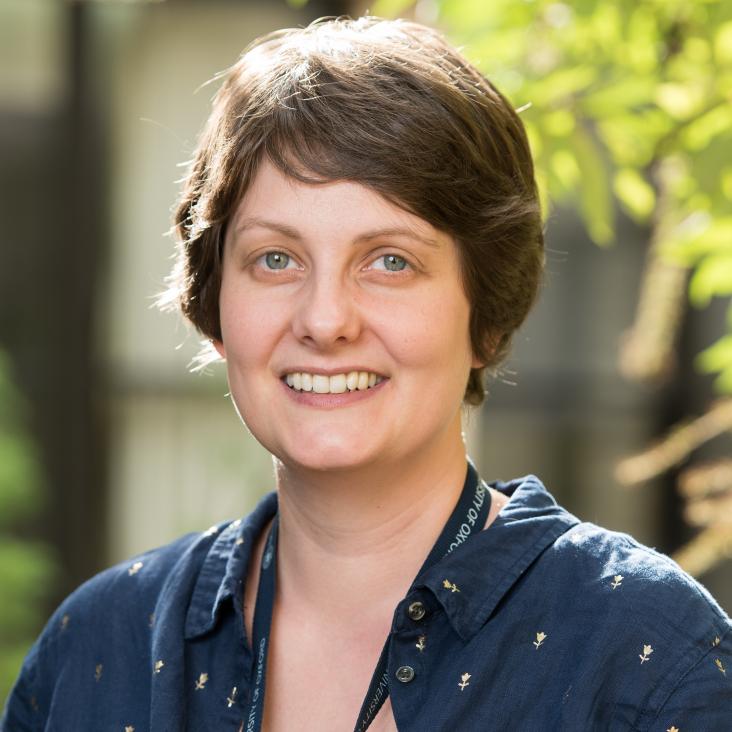
Title: Challenges and Opportunities in HPC for Numerical Relativity
Friday, 6th June 2025, 09:00 - 09:45
Abstract
Numerical relativity is a set of tools for modelling the evolution of dynamical spacetimes in strong gravity regimes. The canonical example of our simulations is a binary black hole merger, where the characterisation of the associated gravitational wave signals is essential for interpreting observational data from the LVK observatories. The same simulations allow us to study physics beyond General Relativity and the Standard Model, including the cosmological singularity, modified gravity, dark matter environments and hypothetical alien warp drives. HPC is essential for these studies and as a result the transition to GPUs presents both challenges and opportunities for our field. In this talk I will give an overview of the current status, and highlight the discovery potential that advances in HPC can unlock.
Short bio
Katy’s research focuses on using numerical solutions to understand the consequences of Einstein’s theory of general relativity, in particular concerning black hole environments and inhomogeneities in the early universe. She is a member of the Geometry, Analysis and Gravitation group in the School of Mathematical Sciences.
Christian Oganbule (EPSRC)

EPSRC Early Career Research: Meet and greet with the funder
Abstract
This is an informal, open discussion round for Early Career Researchers (ECRs). Please bring along your questions regarding EPSRC’s funding schemes and use the opportunity to ask the funder directly on advise, recommendations and clarifications. Feel free to reach out to Christian (Christian.Oganbule@epsrc.ukri.org) ahead of the meeting to let him know about your questions, so you get the most out of the event.
For those who want to have further in-depth conversations about specific calls or projects (or are not that junior anymore), please request an individual meeting slot with Afia Masood (Afia.Masood@epsrc.ukri.org) for Friday morning.